"So"
The anatomy of a scientific staple
by Michael Erard • Posted April 24, 2008 07:02 PM
It's the nouns and verbs that catch our ears first. The complex words, the sediments of Greek and Latin affixes, the long noun phrases, the passive verbs. The surnames of researchers rising and fallen. The journal titles, the acronyms. You can also hear, in that perpetual dance with certainty, the hedges that soften claims ("it was reported that") or strengthen them ("though inconclusive, the data suggests..."). The language of science, with its specialized vocabulary and clipped rhythm, has a distinctive architecture.
The functional elegance of this rarefied speak is uniquely captured in one of its most inconspicuous words: "so." This isn't "so" the intensifier ("so expensive"); it's not the "so" that joins two clauses. This is the "so" that introduces a sentence, as in "So as we can see, modified Newtonian dynamics cannot account for the rotation of any of the three observed galaxies."
This "so" is key to a basic unit of scientific talk: the explanation. What follows "so" is another idea, insight, or fact—not because it's merely next in a series but because it's conceptually consequent: "So when chaperone proteins bind to their receptors, the process allows other bound proteins to expose their signal sequences." The versatility of this precursory "so" allows for a remarkable wealth of potential follow-through. The structure of the word itself makes it extremely useful, namely the sibilant "s" and the long, hollow "o," both of which are infinitely extendable and can carry a wild variety of emotional intonation. There's the curt "so," the wondering, wandering "soooooo," the exploratory "so?" In its crudest form it buys one time. At its most elegant, it facilitates the work of intellectual hopscotch—or Twister, if that's your game. "So" is here a verbal teleporter; it facilitates a leap from A to B that spares the listener the complexity in between without simultaneously dishonoring it. It abbreviates all the data, logic, information, or research experience that one might need to understand what follows. "So" is a transition between the "there" of specialized knowledge and the "here" of explanation.
Advertisement
In this explanatory role, the word frequents the vocabulary of certain groups more than others. While writing his book The New New Thing, Michael Lewis found "so" endemic to Silicon Valley. Microsoft employees claimed it as indigenous to Redmond, Washington, with the rest of their rich lexicon of geek-speak and corporate jive. Employees at Hewlett Packard survived boring meetings by counting the number of "so"s. A joke even circulated: What's the sound of Santa Claus at an HP Christmas party? "So so so!"
An oncology researcher at Johns Hopkins recently confessed to me that he says "so" with such frequency that his patients tease him about it; his colleagues are trying to help him break the habit. He figures he caught it from his boss: "We call it the 'so' virus." Indeed, as a staple entrée into an expository framework, "so" carries with it the attractive connotation of signaling the arrival of privileged information or hard-won knowledge. A mantle of authority easily assumed, if not legitimately earned.
But beyond this, can such a tiny word reveal anything about the metaphorical underpinnings and conceptual structure of scientific endeavors? In the 1990s, Columbia University psychologist Stanley Schachter counted how often professors said "uh" and "um" in lectures and found that humanists said them more than social scientists, and natural scientists said them less frequently of all. Because such words mark places where a speaker is choosing what to say next, Schachter argued, natural scientists' low hesitation rate underscored the hard facts they were communicating. "So" can be said to have the inverse relation for exactly the same reason. It relays a sense of accuracy and rigor. One doesn't have to worry about what to say as much as when to say it. "So" is the organizing device for a logic-driven thought process.
Former Microsoft engineer Alex Barnett wrote on his blog that "so" was a "delaminater" word. To him an idea was a concrete object, much like an onion. "So" was the word a speaker used to convey that another layer was peeling back. This metaphor implies that ideas have a kernel that one could reach with enough "so"s, a notion surely enticing to the problem-solvers and the goal-oriented. I prefer to think of "so" as a vehicle across a landscape of knowledge. It lies not so much in between points on a terminal trajectory, but more on perpetual journey across points of understanding. In this sense it shares some qualities with the infinite "why"s of a two-year-old. Another "so" can always follow the end of a thought. The trajectory is endless; the rabbit hole has no bottom. There will always be more questions for science to answer.
As a word that dwells in the lexicon of those who desire to understand and to learn, "so" is a marker of healthy intellectual tolerance. It is a hallmark of a robust cognitive approach to the world. But this is not to say that the "so" employed by professional explainers is all deduction and dialectic. It also implies an element of faith. This is the faith of any attempt to teach, argue, brainstorm, or present: the conviction that the person who is listening will understand what's being said and comprehend its significance. More than anything else, this fidelity may spring from a need to communicate; a fervent desire to exchange ideas and, in turn, build new ones. This is an inclination characteristic of many people. "So" is just more frequent on the tongues of those who do it best.
Sunday, September 14, 2008


The Pentagon's New Map

The Pentagon's New Map: Basically the U.S. military begins to create the global police force needed to keep order on an integrated, mercantile planet. Nuanced and sharp, collaborationist, not hyper aggressive, dull, and blunt.
Thomas Barnett: from 1998 through 2004, a Senior Strategic Researcher and Professor in the Warfare Analysis & Research Department, Center for Naval Warfare Studies, U.S. Naval War College, Newport, Rhode Island.
From 1998 through 2004, Barnett was a Senior Strategic Researcher and Professor in the Warfare Analysis & Research Department, Center for Naval Warfare Studies, U.S. Naval War College, Newport, Rhode Island.
He's given The Brief to many generals, etc. in the U.S. military...
"Key ideas:
1. Systems of rules called Rule-sets reduce violent conflict. Violence decreases as rules are established (e.g., the WTO Dispute Settlement Understanding) for dealing with international conflicts.
2. The world can be roughly divided into two groups: the Functioning Core, characterized by economic interdependence, and the Non-Integrated Gap, characterized by unstable leadership and absence from international trade. The Core can be sub-divided into Old Core (North America, Western Europe, Japan, Australia) and New Core (China, India). The Disconnected Gap includes the Middle East, South Asia (except India), most of Africa, Southeast Asia, and northwest South America.
3. Integration of the Gap countries into the global economy will provide opportunities for individuals living in the Gap to improve their lives, thereby presenting a desirable alternative to violence and terrorism. The US military is the only force capable of providing the military support to facilitate this integration by serving as the last ditch rule-enforcer. Barnett argues that it has been doing so for over 20 years by "exporting" security (US spends about half of the world's total in military spending).
4. To be successful the US military must stop thinking of war in the context of war but war in the context of "everything else", i.e. demographics, energy, investment, security, politics, trade, immigration, etc.
5. In recognition of its dual role, the US military should organize itself according to two functions, the "Leviathan" and the "System Administrator."
* Leviathan's purpose is employ overwhelming force to end violence quickly. It will take out governments, defend Core countries, and generally do the deterrence work that the US military has been doing since the end of WWII. The Leviathan force is primarily staffed by young aggressive personnel and is overwhelmingly American.
* The SysAdmin's purpose is to wage peace: peacekeeping, nation building, strengthening weak governments, etc. The SysAdmin force is primarily staffed by older, more experienced personnel, though not entirely (he would put the Marines in SysAdmin as the " Mini-me Leviathan"). The sys Admin force would work best as a Core-wide phenomenon.
6. By exporting security, the US and the rest of the Core benefit from increased trade, increased international investment, and other benefits."
Cartesian Wax -- adaptable materials


Neri Oxman is careful not to use traditional terms like "architecture" or "material science" to refer to her work. Instead, she calls it "material ecology," a nod to her belief that design is as much about the work's relationship to and participation in its local environment as it is about the form of the object itself. Oxman finds inspiration in biology; the forms in her work often mimic those found in nature. She doesn't believe biomimicry is a passing fad: "The biological world," she says, "is displacing the machine as a general model of design."
Oxman's "Cartesian Wax" is a material designed to replicate the multiple functionalities of living tissue. It uses a combination of flexible and rigid resin to create a building "skin" that evokes living matter and responds to its local environment; its transparency level is modulated based on local heat and light conditions. The work was inspired by Descartes's Wax Argument: Descartes argued that because we can identify wax as wax, even when its physical properties change in the presence of heat, we know our mind has an important role exceeding that of our limited senses.
A Change in human aesthetics
Da Vinci's Vitruvian Man
http://cfs4.tistory.com/upload_control/download.blog?fhandle=YmxvZzg1MDk3QGZzNC50aXN0b3J5LmNvbTovYXR0YWNoLzEvMTAzLmpwZw==

Alex Grey's Copulating
http://alexgrey.net/a-gallery/cpltng.html

http://cfs4.tistory.com/upload_control/download.blog?fhandle=YmxvZzg1MDk3QGZzNC50aXN0b3J5LmNvbTovYXR0YWNoLzEvMTAzLmpwZw==
Alex Grey's Copulating
http://alexgrey.net/a-gallery/cpltng.html

the next artistic movement?

A call for the next artistic revolution from Ken Wilber:
from meaty finger painting to magical hieroglyphics, mythical Jesus paintings, mental impressions of nature, and aperspectival cubism, now:
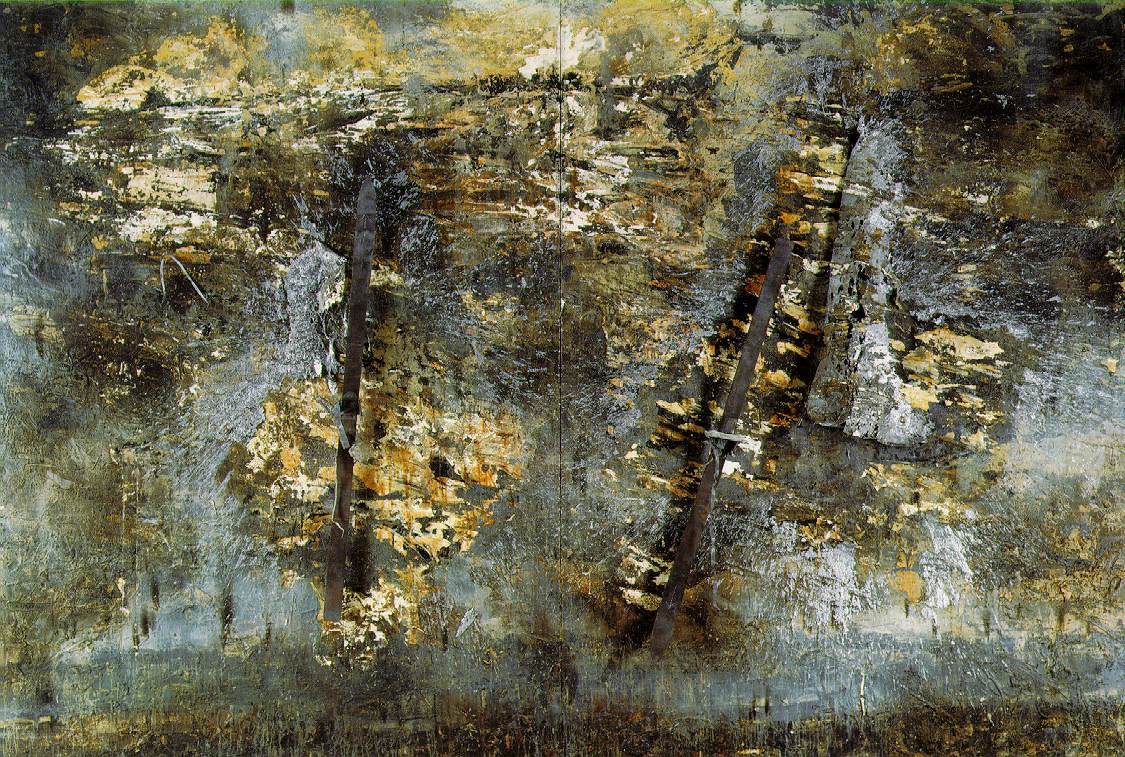
"Who will paint what reality looks like when the ego is anaesthetized, when settling into the corpse pose, it dies to its own wonderment and beholds the world anew? Who will paint that rising landscape? Who will show us that?"
-----------
Ed. Note: Anselm Kiefer (born in Germany in 1945) is one of the most important contemporary artists working today, and probably the major European painter of his generation. Anselm has recently begun exploring spiritual and transcendental concerns in his art. Several of his recent paintings, for example, show a man in a �corpse pose,� signifying the death of the ego or separateself sense. Anselm asked Ken to write an essay for his next major art exhibit.
To See A World--Art and the I of the Beholder
It is not the object expressed, but the depth of the subject expressing it, that most defines art. And this shifts art and art criticism from irony to authenticity -- a rather unnerving move, at least to today�s eyes. Can art and art criticism survive the loss of irony, the loss of inauthenticity, as its central source? And if today�s art abandons sardonic surfaces, where will it finally reside?
* * *
We do not live in a pregiven world. One of the more remarkable tenets of the postmodern revolution in philosophy, psychology, and sociology is that different worldviews exist -- different ways of categorizing, presenting, representing, and organizing our experiences. There is not a single, monolithic world with a single, privileged representation, but rather multiple worlds with pluralistic interpretations. Moreover, these worldviews often -- indeed, almost always -- change from epoch to epoch, and from culture to culture.
This insight need not be taken to extremes -- there are plenty of common features in our various interpretations to prevent the world from falling apart. Indeed, scholars have discovered there are at least some (and often many) universals in languages, in affects, in cognitive structures, and in color perception, to name a few. But these universal ingredients are woven together and organized in a rich variety of ways, resulting in a tapestry of multiple worldviews.
Although there are, in theory, an almost infinite number of worldviews, in the course of human history on this planet, there seem to be about a dozen that have had, or are still having, a widespread and significant influence. Investigated by scholars such as Jean Gebser, Gerald Heard, Jurgen Habermas, Michel Foucault, Robert Bellah, Peter Berger and others, these major worldviews include: sensorimotor, archaic, magic, mythic, mental, existential, psychic, subtle, causal, and nondual. (The exact meaning of those terms will become more obvious as we proceed.)
It is not a matter of which of these worldviews is right and which is wrong; they are all adequate for their time and place. It is more a matter of simply cataloging, as carefully as possible, the very general characteristics that define each worldview, and �bracketing� (or setting aside), for the moment, whether or not they are �true� -- we simply describe all of them as if they were true.
The magicanimistic worldview, for example, is marked by a partial overlap of subject and object, so that �inanimate objects� like rocks and rivers are directly felt to be alive or even to possess souls or subjective spirits. The mythic worldview is marked by a plethora of gods and goddesses, not as abstract entities but as deeply felt powers, each having a rather direct hand in the affairs of earthly men and women. The mental worldview -- of which the �rational worldview� is the best known subset -- is marked by a belief that the subjective realm is fundamentally set apart from the objective realm of nature, and how to relate these two realms becomes one of the most pressing problems in this worldview. The existential worldview possesses an understanding that multiple perspectives are built into the universe, so that not only are there no privileged perspectives, individuals must carve for themselves some sort of meaning from that frightening multitude of possibilities. The subtle worldview is marked by an apprehension of subtle forms and transcendental archetypes, primordial patterns of manifestation which are usually felt (and claimed) to be Divine. The causal worldview is marked by the direct realization of a vast unmanifest realm -- variously known as emptiness, cessation, the Abyss, the Unborn, Ayin, the Ursprung -- a vast Formlessness from which all manifestation springs. And the nondual represents a radical union of the Formless with the entire world of Form.
Those various worldviews present a truly dizzying array of the many ways that our experiences can be organized and interpreted. Those are by no means the only worldviews, nor is the list fixed or predetermined -- it is constantly unfolding with new possibilities. But without some sort of worldview, we remain lost in the blooming buzzing confusion of experience, as William James put it.
In other words, all of our indiv idual perceptions are, to some extent, embedded in particular worldviews. Within those worldviews, we still possess abundant freedom of choice; but worldviews generally constrain what we will even consider choosing. We moderns do not, for example, often get out of bed with the thought, �Time to kill the bear.� Each worldview, with its distinctive characteristics, stamps itself all over those born within it, and most individuals do not know, or even suspect, that their perceptions are occurring within the horizons of a given and rather specific worldview. Each worldview, operating for the most part collectively and unconsciously, simply presents the world as if it were the case. Few question the worldview in which they find themselves, just a fish is unaware it is wet.
Nonetheless -- and here the story takes a decidedly fascinating turn -- research in both individual psychology and crosscultural anthropology demonstrates rather convincingly that, under various circumstances, individuals have available to them the entire spectrum of worldviews. The human mind, it appears, comes with all of these worldviews -- archaic to magic to mythic to mental to subtle to causal -- as potentials in its own makeup, ready to unfold when various factors conspire to allow them to do so, rather like a seed awaiting water, soil, and sun to unfold.
So, even though certain epochs were especially marked by a particular worldview -- foraging, by magic; agrarian, by mythic; and industrial, by mentalrational, for example -- nonetheless, all of these major modes of interpreting our experience seem to be potentials of the human organism, and any of them can be brought forth in any individual under the right circumstances. To the question, �Which worldviews are available to us now?,� the answer appears to be, �All of them.�
Still, at any given time, and in any given culture, most adults tend to inhabit the landscape of one particular worldview. The reason is simple enough: each worldview is, indeed, a person�s world. To lose that world is to experience a type of deathseizure. To surrender a worldview is a psychological earthquake somewhere around 7.0 on the internal Richter scale, and most people avoid this at all costs.
But sometimes, under exceptional circumstances... or in exceptional artists... higher or deeper worldviews break through the crust of our ordinary perceptions, and the world is somehow never quite the same again.
* * *
Artists express worldviews. Paleolithic artists, for example, painted the magical worldspace -- objects overlapping each other, little perspectivism, animistic symbols, few constraints of space and time, wholes interchangeable with their parts. Medieval artists painted the mythic worldspace -- an entire pantheon of angels, archangels, a God, a Son of that God, the Mother of that God, Moses parting the Red Sea -- the themes were the endless possibilities of the mythic worldspace, all depicted, not as symbols, but as realities (precisely because, as we saw, all worldviews present themselves as simply true). With the rise of the very general movement of Modernity in the West -- riding as it did on the mental worldview, with its separation of subjective mind from objective nature -- we see a gradual replacement of mythic themes with themes dominated by nature, by realism, by impressionism, by subjective expressionism, and by abstract expressionism. And with the general rise of Postmodernism, we see those trends carried even further into the existential worldspace, where multiple perspectives, at first a source of endless creativity, soon became a paralyzing nightmare of infinite jest, met with infinite irony.
The existential worldview is called �integralaperspectival� by Gebser -- �aperspectival� because it presents multiple perspectives, none of which are privileged; and �integral� because nonetheless some sort of unity, coherence, or meaning has to be fashioned in the midst of multiplicity. In the previous worldview -- the mentalrational, which Gebser also called �perspectival� -- the single, rational subject tended to take up a single, fixed interpretation of the world, and this was evidenced in everything from science (Newton) to philosophy (Descartes) to portraiture (van Eyck) to perspectivism (starting with Renaissance painting, especially Brunelleschi, Alberti, Donatello, Leonardo, Giotto). But with the shift to integralaperspectival, the subject itself becomes part of the objective scene -- the camera becomes part of the movie, the author�s stream of thought becomes part of the novel, the painter�s own operations show up conspicuously on the canvas. Multiple perspectives draw the subject into the world of objects, making it one object among many others, all lost in a dizzying regress of selfreflexivity, from which there is no escape.
Every worldview has its pathological expressions. The rational worldview�s most notorious is �Cartesian dualism� -- subject split from object, mind divorced from nature -- a dualism against which, it seems, every thinking person of the last three hundred years has vocally declared war. But the postmodern, integralaperspectival stance is not without its own major aberration, known generally as �aperspectival madness,� the insane view that no view is better than another. Starting with the noble proposition that all of the multiple perspectives are to be treated fairly and impartially (�pluralism and rich diversity�), postmodernism slides, in its extreme forms, into the insidious notion that no perspective whatsoever is better than another, a confusion that results in complete paralysis of will, thought, and action. Madness it is indeed: it claims no view is better than another, except its own view, which is superior in a world where nothing is supposed to be superior at all. And worse: if no view is better than another, then the Nazis and the KKK are on the same moral footing as, say, art critics.
�Aperspectival madness� might fairly well describe much of the last two decades of art, art criticism, lit crit, and cultural studies. Irony is one of the few places you can hide in a world of aperspectival madness -- say one thing, mean another, therefore don�t get caught in the embarrassment of taking a stand. (Since, allegedly, no stand is better than another, one simply must not commit -- sincerity is death). So skip sincerity, opt for sardonic. Don�t construct, deconstruct; don�t look for depth, just hug the surfaces; avoid content, offer noise -- �surfaces, surfaces, surfaces is all they ever found,� as Bret Easton Ellis summarized the scene. No wonder that David Foster Wallace, in a recent essay that received much attention, lamented the pervasiveness of the art of �trendy, sardonic exhaustion� and �reflexive irony,� art that is �sophisticated and extremely shallow.�
But if we do abandon irony and seek to make sincere statements, where do we begin? If we do surrender surfaces and look also for the depths, what exactly does that mean? And where are these �depths� to be found?
Wallace suggests that, instead of �reflexive irony,� art should provide �insights and guides to value.� A fine sentiment, but let us note immediately that specific values exist only in specific worldviews. The mythic worldview, for example, valued duty to a rigid social hierarchy, which few moderns find appealing. The mythic worldview also valued male dominance and female subordination, which most enlightened moderns regard as ignorant. All values exist in particular worldviews, and if trendy sardonic exhaustion is actually the exhaustion of the existential worldview, then the only possible conclusion is that we will have to look to other worldviews altogether if we are to escape aperspectival madness and its relentless insincerity.
* * *
The reason that art in the postmodern, existential world has reached something of a culdesac is not that art itself is exhausted, but that the existential worldview is. Just as rational modernity previously exhausted its forms and gave way to aperspectival postmodernity, so now the postmodern itself is on a morbid death watch, with nothing but infinitely mirrored irony to hold its hand, casting flowers where they will not be missed. The skull of postmodernity grins on the near horizon, and in the meantime, we are between two worldviews, one slowly dying, one not yet born.
Whatever we may think about it -- and volumes have been delivered -- perhaps the best that can be said of the avantgarde is that it always implicitly understood itself to be riding the crest of the breaking wave of evolving worldviews. The avantgarde was the leading edge, the growing tip, of an evolving humanity. It would herald the new, announce the forthcoming. It would first spot, then depict, new ways of seeing, new modes of being, new forms of cognition, new heights or depths of feeling, and in all cases, new modes of perception. It would spot, and depict, the coming worldview, while breaking decisively with the old.
The story is familiar. JacquesLouis David�s art was part of the early rise of modernity (reason and revolution) that violently broke with the remnants of the mythic, aristocratic, hierarchical, rococo past. From neoclassicism to abstract expressionism, each succeeding growing tip became in turn the conventional, accepted norm, only to see its own form challenged by the next avantgarde. Even postmodernism, with its aperspectival madness, which first attempted to deconstruct the avantgarde altogether, intimately depended upon it for something to deconstruct; thus, as Donald Kuspit points out in The Cult of the AvantGarde Artist, a type of �neoavantgarde� art inevitably dogged postmodernism from the start.
Like huge successive waves crashing ashore, worldviews succeed one another, and the avantgarde, at its best, were the great surfers of these waves. And now that the postmodern wave is washing on the shore of its own demise, what new waves are forthcoming? What new worldviews surge from the ocean of the soul to announce a new perception? Where are we to look for the contents of the sincere artistic statements that will supplant irony and aperspectival madness? Standing on tiptoe, looking through the mist, can the vague outline of the face of tomorrow�s art -- and therefore, tomorrow�s world -- even be seen?
* * *
What worldviews, from those available, might carry the contours of tomorrow�s art? Of course, some aspects of the coming landscape will be entirely new and original. �Creative advance into novelty,� according to Whitehead, is the basic feature of the universe. But we also know, from extensive psychological and sociological research, that certain basic features of the dozen or so major worldviews, briefly summarized above, are potentials already available to the human organism, and instead of starting entirely from scratch, nature usually reworks what is at hand, before adding the finishing touches of novelty.
We know the worldviews that have been tried, toiled, worked, and exhausted: archaic, magic, mythic, mentalrational (modern), and existentialaperspectival (postmodern). The postmodern, of course, will continue its major influence for decades to come, on the way to its final resting place. It is simply that artistic productions, as canaries in the cultural mine shaft, are dropping dead in alarming numbers as the rotting gas of postmodernity first starts whiffing down that tunnel. So the art world, more quickly than the sturdier herd mentality, seeks out new horizons; and thus, as we earlier noted, the deadend of today�s art is really the future endgame of the postmodern worldview in general. So what other horizons are available right now?
Three, at least. We already named them: subtle, causal, and nondual. The phenomenologists of worldviews (those who research and describe the contours of available worldviews) describe these three worldviews as being transrational or transpersonal, and they contrast them with the earlier worldviews, some of which are prerational or prepersonal (archaic, magic, and mythic), and some of which are rational or personal (mental and existential). This gives men and women, as potentials in their own organisms, a spectrum of available worldviews, ranging from prerational to rational to transrational, from prepersonal to personal to transpersonal, from subconscious to selfconscious to superconscious. Supposing that we have exhausted the dizzying rhetorical regress of selfreflexivity, there are only two ways to go: back into subconsciousness, or forward into superconsciousness -- back to the infrarational, or beyond to the suprarational.
The distinction is important, because the transrational, transpersonal worldviews are what might be called �spiritual,� yet they bear little relation to the traditional religious worldviews of the magic and mythic spheres. The transrational realms have nothing to do with external gods and goddesses, and everything to do with an interior awareness that plumbs the depths of the psyche. Nothing to do with petitionary prayer and ritual, and everything to do with expanding and clarifying awareness. Nothing to do with dogma and belief, everything to do with cleansing perception. Not everlasting life for the ego, but transcending the ego altogether.
When one exhausts the personal, there is left the transpersonal. There is, right now, simply nowhere else to go.
* * *
Not just different values, but different objects, exist in different worldviews. And artists can paint, depict, or express their particular perceptions of the objects in any of these realms, depending on whether or not they are themselves alive to these realms.
The sensorimotor world is familiar enough -- those objects that can be seen with the senses: rocks, birds, bowls of fruit, nudes, landscapes. Artists can, and doggedly have, painted those objects, in everything from a glaringly realistic fashion to the softer tones of impressionism. The magical worldview is one of plastic displacement and condensation, the world of the dream, full of its own very real objects (when dreaming -- when actually in that worldview -- it appears absolutely real, as all worldviews do). Artists can paint those objects, as the Surrealists, among others, have demonstrated. The mythic worldview is full of gods and goddesses, angels and elves, disembodied souls, figures kind and cruel, helpful and malevolent. Artists can paint those objects, and, indeed, most artists around the world, from 10,000 BCE to 1500 CE, painted nothing but those objects. The mental worldview is crowded with concepts and ideas, rational perspectivism and abstract forms. Artists not only can represent those contents (conceptual art, abstract art), they can express them as well (abstract expressionism). The existential (aperspectival) worldview involves, among other things, the terror of the isolated subject confronting an alien world bereft of mythic consolations and rational pretensions. Artists in every medium have depicted this state of affairs, often over-poweringly (e.g., Edvard Munch, �The Shriek�). But the aperspectival worldview is also, at its limits, a subject looking at itself as it tries to look at the world. Artists have attempted to depict this selfreflexive regress in a variety of ways, from deconstruction to ironic reflexivity to doubling (including the artist as part of the art) -- all a dicey game, all headed eventually for selfstrangulation.
Which leaves the transpersonal worldspaces with their contents, themes, and perceptions. All of these realms are, indeed, transpersonal, which simply means those realities that include, but go beyond, the personal and the individual -- wider currents that sweep across the skinencapsulated ego and touch other beings, touch the cosmos, touch spirit, touch patterns and places kept secret to those who hug the surfaces and surround themselves with themselves.
That these transpersonal worldspaces are available to us as great, potential houses does not mean they come with all the furniture. We supply that ourselves. We build, create, add, model, fashion, mold, bring forth, and compose, and here artists in every medium have traditionally led the way, avantgarde in the best and truest sense. So, on the one hand, we might look to the past for those rare occasions where a subculture plugged into the transpersonal realm and brought it forth in art and architecture, poetry and painting, crafts and compositions -- the influence of Zen on Japanese aesthetics, for example. But we can look to the past only for hints, because the house of our tomorrow can only be decorated by artists standing now on the threshold of that unfolding.
What will these furnishings look like? We are standing now in the open clearing, between two worlds, awaiting exactly that birth. But one thing is certain: it will come from the consciousness of men and women who stand open to the transpersonal in their own case, who bring forth, from the depths of the heart and spirit, those radiant realities that speak to us in unmistakable terms. For one thing we have seen: all of the major worldviews are available as potentials in the human bodymind. The deeper the awareness of individuals, the more worldspaces they can plumb. And that is why ultimately, profoundly, inescapably, it is the depth of the subject that provides the objects of art.
We have seen sensory objects, magic objects, mythic objects, mental objects, and aperspectival objects... and we have seen them all exhaust the play of their own significance. Who will show us now the objects of the transpersonal landscape? Who will open themselves to such depths that they can scale these new heights, and return to tell those of us silently waiting what they have seen? Who can stand so far aside from self and same, ego and shame, hope and fear, that the transpersonal comes pouring through them which such a force it rattles the world? Who will paint what reality looks like when the ego is anaesthetized, when settling into the corpse pose, it dies to its own wonderment and beholds the world anew? Who will paint that rising landscape? Who will show us that?
© Ken Wilber, Nov. 1997
©2008 Shambhala Publications
For More Information Send Email to: editors@shambhala.com
Created and Maintained by Mandala Designs
The next architecture
Many of the hottest new statement buildings are going up in Beijing.
Time for a breath of fresh air from the East.
I think there's an argument that these are the vanguard of a new, integrated, organic architecture, with reference to nature and, increasingly, ecology.
Beijing ~is~ a city with a comprehensive solar orientation, a huge temple to agriculture, and a tradition of using humanure on agricultural fields.
The Egg Theatre -- The National Centre for the Peformaning Arts, Beijing
The Bird's Nest -- Beijing National Stadium
Ice Cube -- Beijing National Aquatics Center
Digital Beijing Building
Big Shorts -- China Central Television Headquarters, Beijing
----


Time for a breath of fresh air from the East.
I think there's an argument that these are the vanguard of a new, integrated, organic architecture, with reference to nature and, increasingly, ecology.
Beijing ~is~ a city with a comprehensive solar orientation, a huge temple to agriculture, and a tradition of using humanure on agricultural fields.
The Egg Theatre -- The National Centre for the Peformaning Arts, Beijing
The Bird's Nest -- Beijing National Stadium
Ice Cube -- Beijing National Aquatics Center
Digital Beijing Building
Big Shorts -- China Central Television Headquarters, Beijing
----


Sunday, August 31, 2008
Some Beijing air pollution measures to remain after Olympics

The air pollution control efforts were apparently successful:
"The average daily air pollution index (API) so far this month was 56, far below 81 reported last year. Major air pollutants on average dropped 40 percent over the same period last year, with nitrogen oxide emissions directly related to vehicles down by 61 percent, according to the bureau."
And some of the measures will remain:
"The removal and treatment of heavy-polluting vehicles will be accelerated and plans to reduce construction site dust will be stepped up, Du Shaozhong, deputy director of the Beijing environmental protection bureau, told a news conference.
The city will also require heavily-polluting companies to address their pollution problems as a prerequisite to resuming operations after the Games, he said.
""If they can't resolve the pollution problems, they must stop or limit their production," he said.
"But Wang Li, deputy director of the city's traffic administrative bureau, told the conference that as of yet there are no plans to continue with the odd-even license plate restriction once the Olympics has finished, despite its success in cutting pollution and calls for the continuation of the measure."
Sunday, July 06, 2008
Second Life avatars consume as much electricity as Brazilians

If there are on average between 10,000 and 15,000 avatars "living" in Second Life at any point, that means the world has a population of about 12,500. Supporting those 12,500 avatars requires 4,000 servers as well as the 12,500 PCs the avatars' physical alter egos are using. Conservatively, a PC consumes 120 watts and a server consumes 200 watts. Throw in another 50 watts per server for data-center air conditioning....
Spanish parliament to extend rights to apes

Another step toward reintegrating ourselves with the rest of nature...
-------
Wed Jun 25, 2008 4:27pm EDT
By Martin Roberts
MADRID (Reuters) - Spain's parliament voiced its support on Wednesday for the rights of great apes to life and freedom in what will apparently be the first time any national legislature has called for such rights for non-humans.
Parliament's environmental committee approved resolutions urging Spain to comply with the Great Apes Project, devised by scientists and philosophers who say our closest genetic relatives deserve rights hitherto limited to humans.
"This is a historic day in the struggle for animal rights and in defense of our evolutionary comrades, which will doubtless go down in the history of humanity," said Pedro Pozas, Spanish director of the Great Apes Project.
Spain may be better known abroad for bull-fighting than animal rights but the new measures are the latest move turning once-conservative Spain into a liberal trailblazer.
Spain did not legalize divorce until the 1980s, but Prime Minister Jose Luis Rodriguez Zapatero's Socialist government has legalized gay marriage, reduced the influence of the Catholic Church in education and set up an Equality Ministry.
The new resolutions have cross-party or majority support and are expected to become law and the government is now committed to update the statute book within a year to outlaw harmful experiments on apes in Spain.
"We have no knowledge of great apes being used in experiments in Spain, but there is currently no law preventing that from happening," Pozas said.
Keeping apes for circuses, television commercials or filming will also be forbidden and breaking the new laws will become an offence under Spain's penal code.
Keeping an estimated 315 apes in Spanish zoos will not be illegal, but supporters of the bill say conditions will need to improve drastically in 70 percent of establishments to comply with the new law.
Philosophers Peter Singer and Paola Cavalieri founded the Great Ape Project in 1993, arguing that "non-human hominids" like chimpanzees, gorillas, orang-utans and bonobos should enjoy the right to life, freedom and not to be tortured.
(Reporting by Martin Roberts; Editing by Richard Williams)
© Thomson Reuters 2008. All rights reserved. Users may download and print extracts of content from this website for their own personal and non-commercial use only. Republication or redistribution of Thomson Reuters content, including by framing or similar means, is expressly prohibited without the prior written consent of Thomson Reuters. Thomson Reuters and its logo are registered trademarks or trademarks of the Thomson Reuters group of companies around the world.
Subscribe to:
Posts (Atom)